Saturday, April 23, 2011

My Garden

Dayglo
Old-Fashioned Iris
Instant Smiles
 My official start of spring is when my iris start to bloom.  After freeing them from the jungle of Bermuda grass, they took off and are rewarding me with an embarrassment of riches.  Most of my iris are named varieties but I have quite a few of the old-fashioned purple and yellow iris that have been gracing yards since the beginning of growing iris.  While they may not have the fancy ruffles, variegated colors and clever names of newer types, they are reliable, very hardy and drought tolerant.  Most of mine flourish with rainwater and no fertilizer.  Yet, as the picture shows they still put on a dramatic display every year.

Potatoes & Carrots
I planted peas, potatoes, carrots and lettuce a month or so ago.  Due to some problems with the drip hoses, the lettuce was disrupted twice and had to be replanted but is finally growing well.  The culinary sage that has been in the ground two years now has flourished and rewarded me with a beautiful display and food for insects and hummingbirds.   Planted last fall the garlic will be ready to pick in a few weeks.  Good thing, I ran out of home-grown garlic a couple of months ago.
Garlic
Sage


This is the time of year everyone rushes to get their summer vegetables in but remember the average frost date is mid-May so don't forget to keep on eye on the weather and be prepared to protect young plants.  Yesterday I picked up a few tomatoes and peppers to go in the garden but will wait until next week to put them in.  Sweet potatoes are also waiting in the wings.  I started mine (well, they really started on their own) from grocery store potatoes.  The roots have really started to grow the last few days with the warm weather.  Sweet potatoes grow well here and boy are they good eating!  I don't have quite the same luck with regular potatoes.  This year though they are looking really good so I have my fingers crossed that I will be feasting on them soon.
Carnival Song
This is the time of year when you know that the garden will be great.  The time before the weeds overwhelm you, when the heat saps your energy and you don't have to even start thinking about what you are going to do with all the extra zucchini.

Thursday, March 3, 2011

Spring

It's an absolutely glorious day.  Have you ever noticed that there seems to be a moment between winter and spring.  One day everything is dreary and sad looking and then the next day all the long dormant plants are bursting with energy.  Somehow overnight the iris are bulging with energy, long dormant herbs like my tarragon have sent up a bundle of new shoots.  It was only last week that I couldn't find a trace of them!  The garlic looks lively.  Trees that have lain silent are suddenly exploding with buds.  Don't you just love it. 

Today I planted lettuce, baby bok choy, cabbage and carrots.  I have raised beds so they warm up quickly and the seeds should be sprouting soon.  You should be planting soon too.  If you are not into growing the early spring plants you should be getting the warm weather stuff started so they are ready to transplant as soon as it gets a bit warmer. 

No rest for the gardener this time of year.  Besides who wouldn't want to be outside on a day like today!

Monday, February 21, 2011

Seed Starting


Is your house a bit cold for starting seeds or do you just want to speed up seed germination?  You might try this readers tip from the latest issue of  Fine Gardening magazine.  Take a plastic sweater box and fill it with 200 mini Christmas lights.  Some caveats:  LED lights won't work, they don't give out heat, don't used big incandescent lights without keeping a watchful eye as the heat they generate could melt the plastic.  With all good ideas, improvise with care!  (From April 2011 Fine Gardening magazine)

Gardening Science

Science is fascinating stuff.  Physics and astronomy seem to be the big flashy things we read about.  Giant particle colliders being built and amazing pictures from space are common topics.  While fascinating, every once in awhile cutting edge science is about garden stuff.  What fun!  Some of these really have nothing to do with our day to day garden but are just interesting.  If you are a science geek like I am, (although all the physics articles loose me quickly these days) you need to know about the magazine and website Science News where these articles came from. www.sciencenews.org 

Myth-busting!  I sure everyone has heard you should not to water plants in midday sun.  The idea being that the water droplets on the leaves act as lenses allowing the sun to heat up the leaf surface and burn the leaves.  A graduate student from Hungary decided to test the theory, which had never been scientifically tested before.  He found mostly a myth.  Water droplets tend to flatten on the smooth surface of the leaf and no longer work as a lens.  On leaves with hairs (where the droplet is held above the surface) the droplet does cause some burning but the tests were done in a completely wind free area and they worked to prevent the leaves from moving.  In a natural setting where the leaves bob and weave in the slightest breeze, it is unlikely that the drop stays in place long enough to do any damage.  So don't worry about damaging the leaves from water droplets.  That doesn't mean that you should be watering in the middle of the day and sprinkling the leaves.  There are better ways to water plants in our climate.  Worry about that, don't worry about water droplets.  (Science News Dec 2010-Jan 2011, pg 9)

There has been research on how plants affect their neighbors.  We often think of plants as one big happy family and plant things together willy-nilly.  But plants have the ability to protect their space from competitors.  Walnuts are familiar to most of us.  A chemical they exude prevents other plants from growing underneath their canopy.  Creosote is another example.  Did you know that some plants can detect their siblings and their growth can change depending on whether they are growing next to a sibling vs. a stranger.  Jewelweeds grow more leaves in the presence of strangers (elbowing out strangers) and more roots if next to siblings.  Scientist think this might not be as uncommon as we might think.  (Science News Dec 09, pg 13)

I'm sure we've all seen the pictures of the white spider on the white flower.  The crab spider can change her body color to match the flower.  The question is, does this make the spider a more successful spider than non-camouflaged spiders?  Well maybe no, because insects see in the ultraviolet range where the spider doesn't match the flower color.  The color match also doesn't seem to protect the spider from predators.  It isn't clear yet how the ability to change color helps the spider.  When we marvel over things like this its a good idea not to assume why.  Apparently the why is still to come.  (Science News Dec 5, 09)
Photo from http://bugguide.net

Wednesday, January 26, 2011

Still Winter


Breaking News:  It's still too cold outside to do too much gardening.  Being a wimp when it comes to cold weather I like to rush past January and February to get straight to the gardening season and warmer days.  I received a reminder that January wasn't even over when I forgot to shut off the water on my raised beds yesterday.  When I went out this morning I found a small leak had created this winter wonderland.  Nothing ruins the day like ice!  Fortunately the parsley underneath all the ice won't care but it is a reminder winter cold is still here. 

In spite of that I am fantasizing about my spring garden.  With catalogs filling my mail box its hard not to.  Looking through my Totally Tomatoes catalog and Baker Creek catalogs (great pictures and description) is so exciting.  I found a 'Baby Bok Choy' which would a more practical size for me.  Besides they look really cute.  There is an interesting red cabbage called 'Nero di Toscano or Black Palm Tree' which they say is good in soups and stews.  They also have a wonderful collection of old-fashioned sweet peas, one of my favorite flowers—the ones with that lovely sweet scent. 

It's the summer crops that I live for though, the tomatoes, the peppers, the squash and melons.  One of the more intriging is the tomato, 'Reisetomate'.  It looks like a bunch of cherry, pear tomatoes fused together, but it is not going in my garden.  With limited space, an odd looking tomato would make the cut unless its description reads, "Bright red tomatoes taste--well, rather sour, strong and acid.  The perfect tomato for those who love raw lemons....."  Wish I had more room.  I found others though with a better taste profile.  I might try the tomato called Limmony and another called Andrew Rahart's Jumbo Red.  So many tomatoes, so little space! 

Over the years I've had sporadic luck with melons but this year I'm looking at a bright orange watermelon called 'Orangeglo'.  It is supposed to be the best tasting of the orange-fleshed varieties. 

I already have seeds from the beautiful 'Rouge Vif d'Etemps' pumpkin.  They are huge dark orange beautiful pumpkins.  Tasty too!  Not for jack o' lanterns maybe, but pumpkins are more than just jack o' lanterns.

I could go on and on but lucky you, I'm not going too.  You need to get a catalog or two and start planning your own garden.  By the end of February you should be starting seeds inside.  Get busy the warm weather is on its way!

Thursday, December 30, 2010

Camp Verde Snow Day

As of a couple of days ago I still had at least one hummingbird hanging around.  I really hope he survives this cold snap.  I've kept food out for him because if he hasn't moved on yet, I expect he isn't going to.  As you can see from the picture taken from my front yard this morning, its a bit chilly out.   Not being a snow person,  I think its pretty as long as I don't have to live in it.   Birds though, live outside year round.  In times like these I think they appreciate a few treats.  You can purchase suet blocks or make your own.  Making your own is really easy and could be a fun project if you have kids.   Use cookie cutters to make fun shapes.      

1 cup lard
1 cup crunchy peanut butter
2 cups rolled oats
2 cups cornmeal
1 cup flour
1/2 cup sugar
Other things you will need include cookie cutters, waxed paper and a chopstick or something similar.

Melt the lard and peanut butter in a saucepan at low heat.  Add the remaining ingredients and stir well to form a thick mixture.  Pour or spoon the mix into the cookie cutters to a depth of about 1 inch.  Poke a hole in the suet near the top of each cutter.  Make the hole large enough to thread ribbon or yarn through it.  Put the tray of filled cookie cutters into the freezer for at least a week.  Remove the "cookies" from the cutters and peel off the waxed paper.  Thread ribbon or yarn through each and hang outside.  Makes around 12 cookies. 

(If you don't have cookie cutters,  you can use muffin tins, or simply pour it into a cake pan.  Put wax paper on the bottom.  If you use a cake pan you will have to cut the mixture into smaller pieces once it comes out of the freezer.)

Tuesday, November 23, 2010

New Website & Plant Database

Yavapai County Cooperative Extension

Jeff Schalau and Mary Barnes have finished the conversion of the horticulture information to the new website.  Jeff says that this page will likely take longer to load and there are some other things that aren't as user friendly but there are pluses to the new site.  At the top of the page is a link to Extension publications.  Look to the menu at the left for the horticulture page.  If you have bookmarks to the old site you can still use them but first you will reach a page that will redirect you to the new site.  Take a few minutes and bookmark these new links.

http://extension.arizona.edu/yavapai

There are some differences from the old one so I recommend you spend a bit of time exploring. To get to the main horticulture page use the link below. You can find Jeff's newpaper columns here, a terrific resource since it is searchable.

http://extension.arizona.edu/yavapai/horticulture

From there you can find the Master Gardener pages.  This is the place to find the reporting forms, both electronic and not.  There is also a link to the Arizona Master Gardener Manual, this blog, forms to apply to become a Master Gardener, the Master Gardener Newsletter (there is an index for the newsletter starting in 2000) and a calender.

http://extension.arizona.edu/yavapai/master-gardener-program

One link that is terrific, is the plant database.  This database was created by Master Gardener volunteers and covers around 150 native plants of Yavapai county.  It isn't a complete list, there are portions still in development but the grasses, shrubs and trees sections have a wealth of information.  The listings include several pictures of the plant, description of the species, flower characteristics and habitat information.  If you are a Yavapai County Master Gardener and would like to work on the database contact Mary Barnes.

http://cals.arizona.edu/yavapaiplants/

The links to the new website are posted on the main page of the blog also.  Take some time and and explore the site, it's filled with terrific information.

Science News

It's late November and not much is going on in my garden.  Instead I've been doing one of my other favorite things—reading.  I'll read just about anything someone puts in front of me but one of my favorites is the magazine ScienceNews.  http://www.sciencenews.org/   They do a terrific job of explaining science in friendly terms.  Below are some interesting tidbits.

(SN:7/18/09, pg 12)  The heat of chili peppers apparently protect them from  fungus, but they are more likely to be affected by drought and ants.

(SN Online: 2/13/09) The stress of plants being grown organically could explain the abundance of some micronutrients, ones that protect the plants and aid human health.

(SN Online: 8/25/09)  For those using pomegranate supplements instead of eating the real thing:  don't bother, most of them don't actually contain any of the plant material they claim.

(SN 1/16/10, pg 8)  Deception amongst the squash.  Squash are slight of hand advertisers thanks to a common virus.  When cucumber mosiac virus infects squash plants, the plant starts to smell more attractive to aphids.  Oh by the way, none of this is good news for the gardener!  Anyway the virus attracts the aphids, the aphids take a taste and go "UGH" and move on.  The aphids also pick up the virus and help spread it to other plants.

(SN 1/16/10 pg 8)  Worried about bed bugs, not sure whether you have them?  A low tech, low expense, way to find them has been devised by researchers.  The bugs apparently are attracted by carbon dioxide.  Take about a kilogram (sorry you'll have to figure out how much this is) and put it in a 1/3 gallon insulated jug (available in sporting goods stores).  Don't quite close the opening.  Stand the jug in a low dish and build a paper ramp up to the lip of the bowl.  Dust the bowl with a slight coat of talcum powder.  Leave the room, close the door and leave it alone for 11 hours.  The pesky bugs are attracted to the CO2, climb the ramp, fall into the bowl where the slick sides and talcum powder prevent them from escaping.  Some good news (?) is that modern bed bugs don't live as long without feeding.  Small consolation, but it will save you money by not hiring a pest inspector.

Tuesday, October 26, 2010

New Website!

The “old” Extension website has been closed down.  When it is accessed users will be redirected to the new website.
    Here is the link to the Yavapai County Extension homepage.

http://extension.arizona.edu/yavapai  

Most of what we will use is related to Horticulture and the Master Gardener Program.  When you hover over Horticulture on the left navigation bar, a drop-down menu will come up.   If you click on the word Horticulture (in the left navigation bar) you will get a Horticulture page with not too much on it.   If you click on Home Horticulture on the drop-down menu you will get the Home Horticulture page that contains access to the U of A bulletins, Yavapai County bulletins, the MG Blog, insect and disease diagnostic info, etc.  

    The 2011 Master Gardener class info and application can be accessed from any of the above mentioned pages.
   
The new link will be found in the favorite links box from now on.

2010 Recognitions Picnic

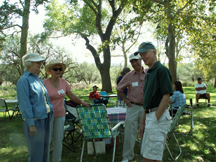
A beautiful day, great food and over 100 Master Gardeners made the 2010 annual Master Gardener Recognition Picnic a smashing success.  Montezuma's Well was the backdrop.  Excellent food was on the menu thanks to Linda Kimberly's master bar-b-quer husband and Kathy MacCauley's food organizational skills with the great cooks among our master gardeners.  Jeff Schalau presented forty-six awards for 150, 250, 500, 1000, 1500 and 2000 hours.  Jeff and Bob Burke, our president, also recognized many Master Gardeners who have made the Yavapai County Master Gardener Association one of the most successful in the country.  The rarified Emeritus club (those with 10 years of continuous MG membership) acquired one new members:  Delores Johnson.
(article by Angela Mazella)

150 Hours
Black, David
Bourdage-Allman, Tana
Gerber, Lisa
Gessner, Bob
Hauserman, Cindy
Heisinger, Pete
Herrick, Merle
Hunter, Donna
Kimmel, Joy
Tierney, Jean
Weesner, Robin
Williams, Rose
Wilson, Deborah

250 Hours
Allen, Debbie
Ames, PJ
Colangelo, Juliette
Cowan, Judy
Downing, Eric
Earls, Ken
Gooslin, Bobbie Jo
Herrick, Michele
Hughes, Kirby
Konzem, Tom
Loos, Betty
McIntyre, Steve
Moody, Steve
O’Laughlin, Jean
Spring, Wendy
Zmyslinski, Ron

500 Hours

Berkshire, Sally
Fleishman, Jay
Kinnen, Sandee
Loving, Connie
Mansoldo, Janet
Millet, Nancy
Russi, Suzette
Selna, Bernadette

1000 Hours
Carter, Cynthia
Howard, Sherry
Smith, Sue


1500 Hours
Art Filippino

2000 Hours
MacCauley, Kathy
Wise, Richard

Emeritus
Delores Johnson