Friday, October 19, 2012

Really, winter's coming

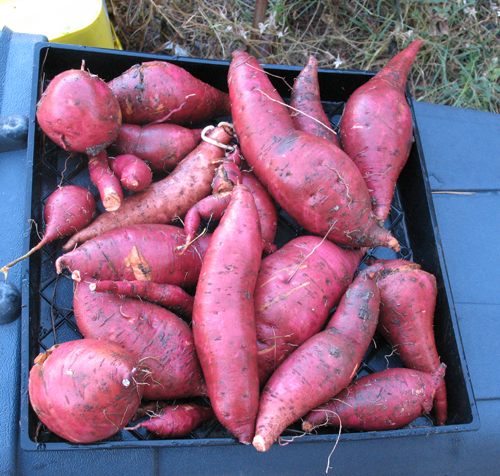
 It's been another long, hot summer and most of the people I know are aching for the cooler days of autumn.  Sometimes it's been hard to tell what the season is by looking at the calendar but the plants know.  A few leaves turning color.  Some plants have finished blooming while the fall bloomers are in their full glory.  The mornings in particular are cooler necessitating a scramble to find a sweater that is taken off an hour later as temperatures go up.  But you can feel it and see it, summer is ending.  I planted my garlic and shallots the other morning.  I pulled out all the tomatoes but one.  It was a terrible tomato year for me except for the cherry tomatoes.  I had tons of those.  Wish I knew what variety they are because I would never plant them again.  Prolific, yes, but with a watery weak flavor.  Even roasting them didn't help much.  Oh well, there is always next year and maybe the label will show up when I pull the plant out.  The peppers were wonderful though.  It was a pimento type and they are still going gangbusters.  Lots of lovely small red peppers.  I haven't dug up the sweet potatoes yet but looks like it will be a good crop.  Another season almost done.

This is the time of year the Master Gardeners get together for their annual recognition picnic.  It's fun, the food is terrific and it's nice to see people recognized for their hard work.   A full list of the Master Gardeners that reached milestones of service will be in the November Yavapai Gardens Newsletter.  You can find the newsletters on the Master Gardener page.
http://extension.arizona.edu/yavapai/master-gardener-program  

For all of those Master Gardeners who did not pass a milestone this year, thanks also for all your hard work.  We have a terrific group of gardeners who work very hard.

Tuesday, July 31, 2012

Curly Top Virus & Cucumber Mosaic Virus


Curly Top Virus

Jeff Schalau, Yavapai County Cooperative Extension Agent has identified cucumber mosaic virus and curly top virus as affecting vegetables in the Verde Valley.  You can get more information by checking out this “Backyard Gardening” article.  (August 1, 2012)


Beet leafhoppers are the source of curly top virus and are common in our area.  When a plant is infected the leaves pucker and are stunted.  The leaves curl and roll upward and the main leaf petiole curves downward.  Leaves look leathery and the veins turn purple while the areas between the veins yellow. 
Cucumber Mosaic Virus

Cucumber mosaic virus can infect tomatoes also.  Aphids spread the virus.  Leaves become mottled and yellow.  New leaves become twisted and curl downward and develop a “shoestring” look.  Plants become stunted and produce only small quantities of fruit.

In both cases once the problem is identified, the plants should be removed immediately.  Do not compost the plants.  The viruses are not carried in the soil so you can replant where the disease plant was growing.  Keeping weeds down may also help prevent the disease.

Monsoon Madness 2012


Article by Angela Mazella   Photos by Steve McIntyre 


This year we got the Monsoon rain without the madness. Like clockwork the rains came at the very opening of this year’s plant sale. It kept the number of customers down (from 704 last year to 504 this year), but surprisingly didn’t hurt our bottom line. The customers came steadily through the day so we missed the usual madness. The half price part of the sale didn’t happen until almost closing. Well at least we didn’t have to water the plants or hydrate our volunteers and customers. 
        The Master Gardener Association really came through with over 1200 plants this year. And they were beautiful with a great variety. Herbs were especially plentiful. Thanks to all the plant makers! We supplemented this with 180 plants from Mountain States and most of them sold as well. 
There were some great garden accessories too. An electric lawn mower, numerous tools and wheel barrows sold well. The rain didn’t stop the tool sharpening operation. They again did a whopping $366 worth of it. 
Thanks to John Mazella and Jeff Schalau and his jazz band for the entertainment. Luckily they managed to keep dry while playing great music. 
This year the committee purchased some tables since we would not be able to access the tables provided by the county. Another step towards self sufficiency for the plant sale. Expenses totaled $1623 and gross sales exceeded last year by $200. This gave us net profits this year of $4717. Only $100 less than last year. We are amazed. Thanks to all the volunteers who made the day possible. I would like to name all 82 of you but have run out of space. It looked like they were all having a good time despite the rain. My impression from speaking to the public is that the Master Gardener Association annual Monsoon Madness plant sale has made it to the must do events in Prescott. Our reputation is so good that everyone asks us when the next sale is. 


Sunday, July 8, 2012

More on Organic Farming


A few months ago I pointed you to an article about how organic farming movement has changed.  As large corporations have taken up the mantle of "organic", the movement is loosing it's meaning and the definitions are changing.  An article in the New York Times documents some of the changes.  The articles is titled "Has 'Organic' Been Oversized?"

The New York Times holds a somewhat tight rein on it's content so I'm not sure you will be able to access the article without an account, but I hope so.  It is an interesting look at corporations, farming and food.


Monsoon Madness is Back!

Saturday, July 14, Yavapai County Cooperative Extension Master Gardeners are having their Monsoon Madness gardeners sale.  The sale runs from 7:30am to 1pm. This is a great opportunity to purchase plants grown by the Master Gardeners and used gardening equipment.  There will be herbs, perennials, annuals, natives and house plants available.


Along with the plant sale you can bring your pruning shears, knives, loppers and axes to be sharpened (no serrated edges).  Workshops are also scheduled on planting, watering composting, insect control and more.


Sales are cash only!


Location: 
Prescott Frontier Days Rodeo Grounds
840 Rodeo Dr.
PrescottAZ 86305

Friday, April 13, 2012

Spring

Batik
 The first bright spot in my garden every year are the iris.  They grow with a minimum of care and water.  I have quite a stand of an older variety that just survives on rainwater.  Some of the newer varieties need a bit of help but reward you with some spectacular blooms.  If you are looking for a plant for a low water garden, iris are a great addition.  The Prescott Area Iris Society is having three sales this summer where you can pick up some rhizomes.  Club members will be at the sales to answer questions.  Iris are planted in the summer so the sale is in July.  Mark your calendars now!


Prescott Area Iris Society (PAIS)
Join PAIS for our annual iris rhizome sale with hundreds of Iris for sale, all colors of the rainbow. Proceeds used to purchase educational materials for library system and maintain Iris beds at Yavapai College Sculpture Garden.
For information call (928) 776-7217 or (602) 300-5791. Visit our web site at:  http://www.prescottirissociety.org.


Carnival Song
Sharlot Hall Museum
415 N. Gurley Street, Prescott, AZ
Saturday, July 21, 2012 11:00AM to 5:00PM
Sunday, July 22, 2012 12:00PM to 4:00PM


Lavender Tea House
1097 N. James, Chino Valley, AZ
Friday July 27, 2012 10:00AM to 2:00PM

Dan’s Garden


17618 Foothill Road, Yarnell, AZ
Saturday, July 28, 2012 10:00AM to 2:00PM


Parvins Pinot


I'm gearing up for the vegetable garden.  I picked up tomatoes and peppers at Verde River Growers in Cottonwood the other day.  Beautiful plants, now I just have to take care of them enough to have beautiful tomatoes and peppers.  The garlic now growing will be ready to pick in another month or so, depending on how fast it gets hot.  I also have leeks, onions and shallots that are really coming along.  My big goof so far is that I haven't started any sweet potatoes.  It is probably too late but I am going to give it a shot as I love homegrown sweet potatoes.  Plan on putting in some melons yet, but they can wait till it warms up a bit.  

Sunday, January 1, 2012

The Changing Face of Organic Farming

Frost on Lamb's Ear plant
Happy New Year!  I never get too excited about New Years as a holiday.  It's just another day in my world.  I am not a football person, so I will not be sitting around.  The temperature today is supposed to be 70°F and then tomorrow it is going up to 72°F (a good reason to live in Arizona!) it might be a good time to take care of some outdoor chores.  


We are not that far away from planting.  Hard to believe, It seems that it was just a few days ago that last year's garden finally froze.  While we are waiting for spring you might want to explore some interesting news that popped up the last couple of days.  The first is about how organic farming is becoming a big corporate business and what that could mean.  It talks about organic farming in Baja California, Mexico and how farming in a arid region affects the water table and the local economy and environment.  The article is a must read if you shop at Whole Foods or any organic food aisle.
http://www.nytimes.com/2011/12/31/science/earth/questions-about-organic-produce-and-sustainability.html?nl=todaysheadlines&emc=tha2

The second article is about how corn farmers are finding that rootworms have acquired immunity to Bt in gene modified corn.  Farmers have been reporting problems in four different midwestern states.  While scientists expected resistance to develop, they never expected it this fast.  Nature has a way at confounding scientists and their expectations.

http://www.google.com/hostednews/ap/article/ALeqM5jw-12gzIiXCIYbaMtSPhyVkLfo3Q?docId=87d15e7b2ecb46619daf0e5ae9c94457

Thursday, September 22, 2011

Yavapai County Fair

I'm running a bit late on this but it's time for the fair and you can still enter your produce and flowers.  The information is too long to include here so go to timstoyotacenter.com/events 
At the bottom of the page there is a link to the fair book with all the entry dates and rules.  The fair is being held at Tim's Toyota Center in Prescott Valley instead of the county fairgrounds this year.   The dates of the fair are September 29 to October 2.


Tim's Toyota Center
3201 N. MAIN STREET   
PRESCOTT VALLEY ARIZONA 
PHONE:  928-772-1819  

Saturday, September 10, 2011

2011 Highlands Garden Conference


Every four years the Yavapai County Master Gardeners organize a gardening conference.   The conference gives us a great opportunity to think out of the box.  It’s a time for us to learn new things, maybe expand our horizons, widen our world view.  This year’s conference will hopefully do all of those things.  Below is a bit of information about the speakers.  Don’t forget about the pre-conference tours.  Registration is open until October 13.  Late registration rates do apply, but it's worth it.  http://cals.arizona.edu/yavapai/ahgc/
The keynote speakers will be selling and signing their books after their programs.

Dr. Linda Chalker  Scott has been poking holes in gardening dogma or confirming our sometimes crazy ideas for years.  Pick a subject, mulches, fertilizers, pruning, you name it she has done research to find out what really works or not, scientifically.  She has a several websites, her university website: (http://www.puyallup.wsu.edu/~linda%20chalker-scott/Horticultural%20Myths_files/index.html) and along with a number of other horticulture professors a blog: https://sharepoint.cahnrs.wsu.edu/blogs/urbanhort/default.aspx

Her topic:  Garden Myths: practices and products:  The number of garden products on the market is dizzying – which ones are good?  Which are a waste of your money?  And which cause more harm than good to your garden?  This seminar will begin with a brief overview of how to interpret marketing claims, with a particular focus on scientific credibility.  We’ll then look at three case studies of popular gardening products and determine whether they benefit your gardens – or simply someone else’s wallet.  At the end of seminar we’ll consider some simple, inexpensive, yet effective alternatives for a sustainable, healthy garden.

 Our second keynote speaker is Dr. Whitney Cransahw from Colorado State University where he is an Extension specialist.  Author of several books he brings not only years of experience but a love for the topic. He will be doing two programs, the morning keynote and a session in the afternoon.

His keynote is:  Gardening for Insects - or Not!  The types of choices gardeners make in terms of plant selection and landscaping can have major impacts on the types of insects that will be found in the yard and garden.  Some of these insects can be considered desirable because they are attractive (e.g., butterflies), have interesting habits (e.g., hummingbird moths), are important pollinators (e.g., bees) or assist in the control of pest species.  Others create problems.  This discussion with consider how to manipulate garden designs to attract - or avoid - several common insects.

Session:  Recognizing Natural Enemies of Insect Pests (Life Styles of the Swift and Vicious)  Assisting the management of all insects are various natural enemies - predators that and hunt and consume pest insects, lethal parasitoids that develop internally, and pathogens.  Although some of these are readily recognized by gardeners, such as lady beetles, others are less well known.  Furthermore, certain life stages, such as eggs or larvae, may not be well identified.  This discussion will review the most common natural enemies of garden insects, including their identification, general habits, and conservation.

Other sessions include

There's a snake in my garden! Is it dangerous? Are there more of them nearby? Everything you need to know about reptiles and amphibians of Yavapai county from an Arizona herpetologist. Learn how to distinguish between a rattlesnake and harmless impostors, what to do if you see one, and get expert tips on how to keep them out of your yard. Live rattlesnakes from Yavapai county will be on-hand to show you exactly what to look for and dispel myths surrounding our most iconic desert animal."

Drip Irrigation for the Home Gardens:  Frank Martin will be discussing the use and installation of simple drip irrigation systems for the home garden and landscape plants.  It will include information on components of the various systems, included emitters, filters, pressure regulators and the appropriate distribution system. I heard he will talk a bit about rainwater systems too!

Chickens
Would you like delicious fresh eggs every day from your very own chickens?  Rachel Bess will show you how easy it is to keep laying hens in your backyard year round, even in the city!
      Chickens make great pets, efficient bug and weed eaters and excellent soil tillers, not to mention that they provide us with wonderful fresh eggs. Learn everything you want to know about how to raise chickens in your backyard. It's easy, fun and very rewarding!

And there is more! New Plant Selections from Mountain States Nursery. Integrated Pest Management by a representative from Arbico who specializes in beneficial insects. Abiotic Factors on Plants, what?  Most people don’t really knows what this is, but it’s all those things that affect plant growth that you don’t think about. Zen Mocarski from Arizona Game and Fish will be talking about Urban Wildlife Issues.  You can ask him what to do with large problem pests. Gene Twaronite will talk about Native Cold Hardy Cactus.  Since Gene is from the Prescott area he knows what works best for this area.

Register now!  Hope to see you there.  http://cals.arizona.edu/yavapai/ahgc/


Monday, July 25, 2011

Monsoon Madness 2011


Monsoon Madness 4

The fourth annual Monsoon Madness plant sale was bigger and better than ever.

Thanks to the many master gardeners who grew healthy and happy plants for the sale. We had an incredible variety of herbs, houseplants, annuals and perennials, with very little left over after the sale. The Committee even purchased about 100 plants from Mountain States to round out the xeriscape offerings. Those all sold as well. The large selection of garden pots, fencing, outdoor furniture and other miscellaneous garden art rounded out the yard sale part of Monsoon Madness.

Besides the favorite tool sharpening services we have offered in our events, this year “Garden Bites” was added. These were 15-minute presentations on transplanting, composting, perennial gardens, vermiculture, garden safety and tree diseases and pests. The talks were well attended. This rounded off the expertise we offered to the public.

Then there was the entertainment. John Mazella performed solo guitar during the early morning rush and Jeff Schalau and his wife joined their newly formed and very talented Jazz band for the rest of the sale.

Our 78 volunteer master gardeners were kept very busy answering questions about selection and planting their purchases.  We had 704 eager customers this year. 

The usual monsoon rains held off until noon so the eager left over crowd could take advantage of the half price sale. All this fun and hard work amounted to a profit of $4921 for the Association. This was part of the “better than ever” as it was $400 more than last year.  We could not have done it without the hard work and support of all of the 78 volunteer and committee members of the Yavapai Master Gardener’s Association.

To see more pictures of the sale and past events click the Flickr link to the right.


Sunday, June 19, 2011

Garden Sale, Prescott, AZ, July 9, 2011

Monsoon Madness 
Plant and Yard Sale
July 9, 2011
Prescott, Arizona

The fourth annual Monsoon Madness plant and yard sale takes place July 9 from 7:30 a.m. to 1 p.m. at the rodeo grounds, 840 Rodeo Drive in Prescott. The University of Arizona Yavapai County Master Gardener Association is the event sponsor. There will be a wide variety of plants, garden tools, pots and garden art for sale. There will also be gardening and planting advice from area expert master gardeners. A continuous series of 15-minute workshops called Gardening Bites will discuss planting, watering, composting, insect control and other topics of interest. Live entertainment will be provided by local musicians.

There will be a tool- and knife-sharpening table, so bring your knives, pruners, shearers, loppers and axes (no serrated edges, please) for a tune-up.

All sales are cash only. For more information, call 445-6590, ext. 222, or visit http://extension.arizona.edu/yavapai.

June 19

One of the greatest things in the world is to be able to walk out to the garden and pick your dinner or at least part of your dinner.  It's the payoff to the hard work of gardening.  While I'm still waiting for tomatoes, the carrots and potatoes are enough to hold me over.  With homegrown garlic and onions one of my favorite things to do is simply roast them in the oven with some fresh herbs.  Roasting intensifies the flavors and sweetness of the vegetables.  It makes a nice dish on its own or as a complement to any meat dish. 

As for my tomatoes, as you can see, they are a ways away from being ripe but I have lots of fruit on the vines.  Since tomatoes don't usually set much fruit in the hottest part of the summer, it's nice to know that I have something to look forward to as the temperature goes up. 


July isn't something most of us look forward to.  After the fireworks of July 4th celebrations I think most of us want to hibernate away from the heat.  While I know it's tempting, there are still things you can do in the garden.  The monsoons are coming and it is a nice time to plant native or drought tolerant perennials.  The monsoon rains (assuming we get them) are perfect for jump-starting desert adapted plants.  Also plant melons and squash.  Native Seed Search in Tucson has many varieties that have been cultivated by Native Americans for centuries that are specifically adapted to monsoon rainfall.    They also have a store in Tucson if you happen to be driving through.

Just remember if the rains don't show up, you will have to water.  Everyone do a rain dance!

Native Seed Search
http://www.nativeseeds.org/
Store location and mail orders:
3061 N. Campbell Avenue. Tucson, AZ 85719
Phone: 520-622-5561
Toll Free: 866-622-5561
Fax (orders welcome): 520-622-5591
Summer Store Hours (June 1st - August 31st):
Monday thru Saturday - 10 am - 5 pm.  Closed on Sunday.

Saturday, April 23, 2011

My Garden

Dayglo
Old-Fashioned Iris
Instant Smiles
 My official start of spring is when my iris start to bloom.  After freeing them from the jungle of Bermuda grass, they took off and are rewarding me with an embarrassment of riches.  Most of my iris are named varieties but I have quite a few of the old-fashioned purple and yellow iris that have been gracing yards since the beginning of growing iris.  While they may not have the fancy ruffles, variegated colors and clever names of newer types, they are reliable, very hardy and drought tolerant.  Most of mine flourish with rainwater and no fertilizer.  Yet, as the picture shows they still put on a dramatic display every year.

Potatoes & Carrots
I planted peas, potatoes, carrots and lettuce a month or so ago.  Due to some problems with the drip hoses, the lettuce was disrupted twice and had to be replanted but is finally growing well.  The culinary sage that has been in the ground two years now has flourished and rewarded me with a beautiful display and food for insects and hummingbirds.   Planted last fall the garlic will be ready to pick in a few weeks.  Good thing, I ran out of home-grown garlic a couple of months ago.
Garlic
Sage


This is the time of year everyone rushes to get their summer vegetables in but remember the average frost date is mid-May so don't forget to keep on eye on the weather and be prepared to protect young plants.  Yesterday I picked up a few tomatoes and peppers to go in the garden but will wait until next week to put them in.  Sweet potatoes are also waiting in the wings.  I started mine (well, they really started on their own) from grocery store potatoes.  The roots have really started to grow the last few days with the warm weather.  Sweet potatoes grow well here and boy are they good eating!  I don't have quite the same luck with regular potatoes.  This year though they are looking really good so I have my fingers crossed that I will be feasting on them soon.
Carnival Song
This is the time of year when you know that the garden will be great.  The time before the weeds overwhelm you, when the heat saps your energy and you don't have to even start thinking about what you are going to do with all the extra zucchini.

Thursday, March 3, 2011

Spring

It's an absolutely glorious day.  Have you ever noticed that there seems to be a moment between winter and spring.  One day everything is dreary and sad looking and then the next day all the long dormant plants are bursting with energy.  Somehow overnight the iris are bulging with energy, long dormant herbs like my tarragon have sent up a bundle of new shoots.  It was only last week that I couldn't find a trace of them!  The garlic looks lively.  Trees that have lain silent are suddenly exploding with buds.  Don't you just love it. 

Today I planted lettuce, baby bok choy, cabbage and carrots.  I have raised beds so they warm up quickly and the seeds should be sprouting soon.  You should be planting soon too.  If you are not into growing the early spring plants you should be getting the warm weather stuff started so they are ready to transplant as soon as it gets a bit warmer. 

No rest for the gardener this time of year.  Besides who wouldn't want to be outside on a day like today!

Monday, February 21, 2011

Seed Starting


Is your house a bit cold for starting seeds or do you just want to speed up seed germination?  You might try this readers tip from the latest issue of  Fine Gardening magazine.  Take a plastic sweater box and fill it with 200 mini Christmas lights.  Some caveats:  LED lights won't work, they don't give out heat, don't used big incandescent lights without keeping a watchful eye as the heat they generate could melt the plastic.  With all good ideas, improvise with care!  (From April 2011 Fine Gardening magazine)

Gardening Science

Science is fascinating stuff.  Physics and astronomy seem to be the big flashy things we read about.  Giant particle colliders being built and amazing pictures from space are common topics.  While fascinating, every once in awhile cutting edge science is about garden stuff.  What fun!  Some of these really have nothing to do with our day to day garden but are just interesting.  If you are a science geek like I am, (although all the physics articles loose me quickly these days) you need to know about the magazine and website Science News where these articles came from. www.sciencenews.org 

Myth-busting!  I sure everyone has heard you should not to water plants in midday sun.  The idea being that the water droplets on the leaves act as lenses allowing the sun to heat up the leaf surface and burn the leaves.  A graduate student from Hungary decided to test the theory, which had never been scientifically tested before.  He found mostly a myth.  Water droplets tend to flatten on the smooth surface of the leaf and no longer work as a lens.  On leaves with hairs (where the droplet is held above the surface) the droplet does cause some burning but the tests were done in a completely wind free area and they worked to prevent the leaves from moving.  In a natural setting where the leaves bob and weave in the slightest breeze, it is unlikely that the drop stays in place long enough to do any damage.  So don't worry about damaging the leaves from water droplets.  That doesn't mean that you should be watering in the middle of the day and sprinkling the leaves.  There are better ways to water plants in our climate.  Worry about that, don't worry about water droplets.  (Science News Dec 2010-Jan 2011, pg 9)

There has been research on how plants affect their neighbors.  We often think of plants as one big happy family and plant things together willy-nilly.  But plants have the ability to protect their space from competitors.  Walnuts are familiar to most of us.  A chemical they exude prevents other plants from growing underneath their canopy.  Creosote is another example.  Did you know that some plants can detect their siblings and their growth can change depending on whether they are growing next to a sibling vs. a stranger.  Jewelweeds grow more leaves in the presence of strangers (elbowing out strangers) and more roots if next to siblings.  Scientist think this might not be as uncommon as we might think.  (Science News Dec 09, pg 13)

I'm sure we've all seen the pictures of the white spider on the white flower.  The crab spider can change her body color to match the flower.  The question is, does this make the spider a more successful spider than non-camouflaged spiders?  Well maybe no, because insects see in the ultraviolet range where the spider doesn't match the flower color.  The color match also doesn't seem to protect the spider from predators.  It isn't clear yet how the ability to change color helps the spider.  When we marvel over things like this its a good idea not to assume why.  Apparently the why is still to come.  (Science News Dec 5, 09)
Photo from http://bugguide.net

Wednesday, January 26, 2011

Still Winter


Breaking News:  It's still too cold outside to do too much gardening.  Being a wimp when it comes to cold weather I like to rush past January and February to get straight to the gardening season and warmer days.  I received a reminder that January wasn't even over when I forgot to shut off the water on my raised beds yesterday.  When I went out this morning I found a small leak had created this winter wonderland.  Nothing ruins the day like ice!  Fortunately the parsley underneath all the ice won't care but it is a reminder winter cold is still here. 

In spite of that I am fantasizing about my spring garden.  With catalogs filling my mail box its hard not to.  Looking through my Totally Tomatoes catalog and Baker Creek catalogs (great pictures and description) is so exciting.  I found a 'Baby Bok Choy' which would a more practical size for me.  Besides they look really cute.  There is an interesting red cabbage called 'Nero di Toscano or Black Palm Tree' which they say is good in soups and stews.  They also have a wonderful collection of old-fashioned sweet peas, one of my favorite flowers—the ones with that lovely sweet scent. 

It's the summer crops that I live for though, the tomatoes, the peppers, the squash and melons.  One of the more intriging is the tomato, 'Reisetomate'.  It looks like a bunch of cherry, pear tomatoes fused together, but it is not going in my garden.  With limited space, an odd looking tomato would make the cut unless its description reads, "Bright red tomatoes taste--well, rather sour, strong and acid.  The perfect tomato for those who love raw lemons....."  Wish I had more room.  I found others though with a better taste profile.  I might try the tomato called Limmony and another called Andrew Rahart's Jumbo Red.  So many tomatoes, so little space! 

Over the years I've had sporadic luck with melons but this year I'm looking at a bright orange watermelon called 'Orangeglo'.  It is supposed to be the best tasting of the orange-fleshed varieties. 

I already have seeds from the beautiful 'Rouge Vif d'Etemps' pumpkin.  They are huge dark orange beautiful pumpkins.  Tasty too!  Not for jack o' lanterns maybe, but pumpkins are more than just jack o' lanterns.

I could go on and on but lucky you, I'm not going too.  You need to get a catalog or two and start planning your own garden.  By the end of February you should be starting seeds inside.  Get busy the warm weather is on its way!

Thursday, December 30, 2010

Camp Verde Snow Day

As of a couple of days ago I still had at least one hummingbird hanging around.  I really hope he survives this cold snap.  I've kept food out for him because if he hasn't moved on yet, I expect he isn't going to.  As you can see from the picture taken from my front yard this morning, its a bit chilly out.   Not being a snow person,  I think its pretty as long as I don't have to live in it.   Birds though, live outside year round.  In times like these I think they appreciate a few treats.  You can purchase suet blocks or make your own.  Making your own is really easy and could be a fun project if you have kids.   Use cookie cutters to make fun shapes.      

1 cup lard
1 cup crunchy peanut butter
2 cups rolled oats
2 cups cornmeal
1 cup flour
1/2 cup sugar
Other things you will need include cookie cutters, waxed paper and a chopstick or something similar.

Melt the lard and peanut butter in a saucepan at low heat.  Add the remaining ingredients and stir well to form a thick mixture.  Pour or spoon the mix into the cookie cutters to a depth of about 1 inch.  Poke a hole in the suet near the top of each cutter.  Make the hole large enough to thread ribbon or yarn through it.  Put the tray of filled cookie cutters into the freezer for at least a week.  Remove the "cookies" from the cutters and peel off the waxed paper.  Thread ribbon or yarn through each and hang outside.  Makes around 12 cookies. 

(If you don't have cookie cutters,  you can use muffin tins, or simply pour it into a cake pan.  Put wax paper on the bottom.  If you use a cake pan you will have to cut the mixture into smaller pieces once it comes out of the freezer.)

Tuesday, November 23, 2010

New Website & Plant Database

Yavapai County Cooperative Extension

Jeff Schalau and Mary Barnes have finished the conversion of the horticulture information to the new website.  Jeff says that this page will likely take longer to load and there are some other things that aren't as user friendly but there are pluses to the new site.  At the top of the page is a link to Extension publications.  Look to the menu at the left for the horticulture page.  If you have bookmarks to the old site you can still use them but first you will reach a page that will redirect you to the new site.  Take a few minutes and bookmark these new links.

http://extension.arizona.edu/yavapai

There are some differences from the old one so I recommend you spend a bit of time exploring. To get to the main horticulture page use the link below. You can find Jeff's newpaper columns here, a terrific resource since it is searchable.

http://extension.arizona.edu/yavapai/horticulture

From there you can find the Master Gardener pages.  This is the place to find the reporting forms, both electronic and not.  There is also a link to the Arizona Master Gardener Manual, this blog, forms to apply to become a Master Gardener, the Master Gardener Newsletter (there is an index for the newsletter starting in 2000) and a calender.

http://extension.arizona.edu/yavapai/master-gardener-program

One link that is terrific, is the plant database.  This database was created by Master Gardener volunteers and covers around 150 native plants of Yavapai county.  It isn't a complete list, there are portions still in development but the grasses, shrubs and trees sections have a wealth of information.  The listings include several pictures of the plant, description of the species, flower characteristics and habitat information.  If you are a Yavapai County Master Gardener and would like to work on the database contact Mary Barnes.

http://cals.arizona.edu/yavapaiplants/

The links to the new website are posted on the main page of the blog also.  Take some time and and explore the site, it's filled with terrific information.

Science News

It's late November and not much is going on in my garden.  Instead I've been doing one of my other favorite things—reading.  I'll read just about anything someone puts in front of me but one of my favorites is the magazine ScienceNews.  http://www.sciencenews.org/   They do a terrific job of explaining science in friendly terms.  Below are some interesting tidbits.

(SN:7/18/09, pg 12)  The heat of chili peppers apparently protect them from  fungus, but they are more likely to be affected by drought and ants.

(SN Online: 2/13/09) The stress of plants being grown organically could explain the abundance of some micronutrients, ones that protect the plants and aid human health.

(SN Online: 8/25/09)  For those using pomegranate supplements instead of eating the real thing:  don't bother, most of them don't actually contain any of the plant material they claim.

(SN 1/16/10, pg 8)  Deception amongst the squash.  Squash are slight of hand advertisers thanks to a common virus.  When cucumber mosiac virus infects squash plants, the plant starts to smell more attractive to aphids.  Oh by the way, none of this is good news for the gardener!  Anyway the virus attracts the aphids, the aphids take a taste and go "UGH" and move on.  The aphids also pick up the virus and help spread it to other plants.

(SN 1/16/10 pg 8)  Worried about bed bugs, not sure whether you have them?  A low tech, low expense, way to find them has been devised by researchers.  The bugs apparently are attracted by carbon dioxide.  Take about a kilogram (sorry you'll have to figure out how much this is) and put it in a 1/3 gallon insulated jug (available in sporting goods stores).  Don't quite close the opening.  Stand the jug in a low dish and build a paper ramp up to the lip of the bowl.  Dust the bowl with a slight coat of talcum powder.  Leave the room, close the door and leave it alone for 11 hours.  The pesky bugs are attracted to the CO2, climb the ramp, fall into the bowl where the slick sides and talcum powder prevent them from escaping.  Some good news (?) is that modern bed bugs don't live as long without feeding.  Small consolation, but it will save you money by not hiring a pest inspector.